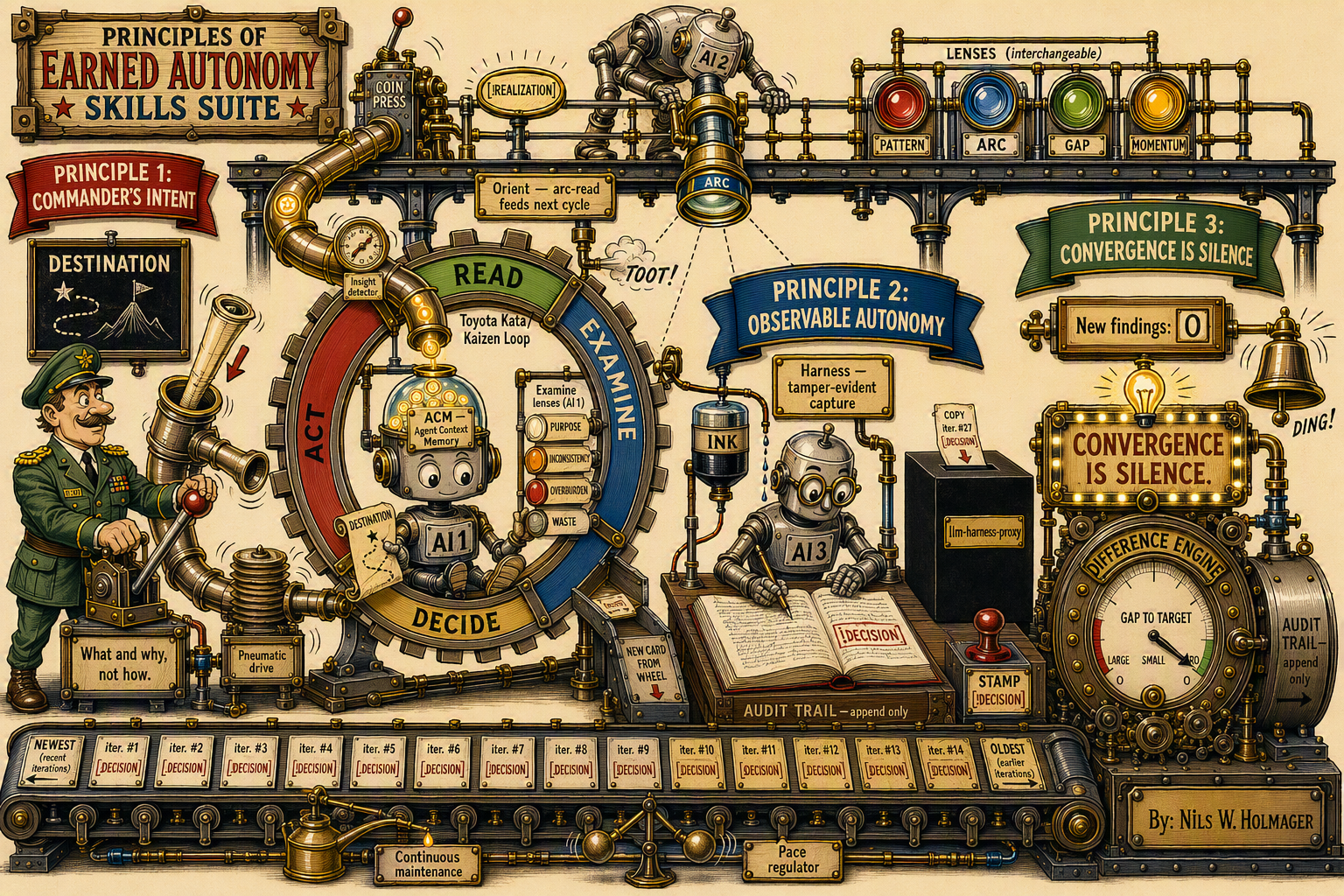
Conceptual traditions
Auftragstaktik (Mission Command)
Subordinates are told what and why - never how. The direct origin of Operator's Intent.
19th century military doctrine, German General Staff
Applies in: Principle 1 - Operator's Intent, Intent skill
Socratic Method
Reasoning through questions, not assertions. The instruction asks; the agent answers from its own situated reasoning.
Socratic method · classical antiquity
Applies in: Principle 1 - Operator's Intent, Probe skill
Winograd Schema Challenge
Minimal pairs - two cases differing in one material way - test whether a system is reasoning about the specific case or pattern-matching a category. The direct technique ancestor of Probe's contrastive-pair mechanism.
Levesque, Davis & Morgenstern · KR 2012
Applies in: Probe skill, ARF
CheckList
Behavioral testing of NLP models via invariance and minimal-pair tests - evaluating a model the way software is tested against a spec, not just by aggregate accuracy. The second technique ancestor of Probe's contrastive-pair mechanism.
Ribeiro, Wu, Guestrin & Singh · ACL 2020
Applies in: Probe skill, ARF
Saltzer & Schroeder - Separation of Privilege (1975)
A mechanism requiring two independent parties is more robust than one that trusts a single key-holder. Observable Autonomy transfers this structure from access control to the epistemic record: the party that acts must not also be the sole author of the account of its action - no single act of self-narration should be sufficient to compromise the integrity of the trail. The principle is theirs; the transfer to an autonomous agent's reasoning record is what PEA adds.
Jerome H. Saltzer & Michael D. Schroeder · MIT, Proceedings of the IEEE 63(9), 1975
Applies in: Principle 2 - Observable Autonomy
The Two-Person Rule (Sagan, 1993)
Nuclear command-and-control requires two independent parties to authorize launch - no single operator can act alone, and no single party can fabricate the authorization record. The same separation-of-privilege logic as Saltzer & Schroeder, independently arrived at in the highest-stakes deployment humans have built.
Scott D. Sagan, The Limits of Safety: Organizations, Accidents, and Nuclear Weapons · Princeton University Press, 1993
Applies in: Principle 2 - Observable Autonomy
Truth Commissions (Hayner, 2011)
Truth commissions construct the official historical record from independent testimony and documentary evidence - the account of what happened is never authored solely by the perpetrators. A third independent domain converging on the same rule Observable Autonomy transfers to an agent's reasoning record.
Priscilla B. Hayner, Unspeakable Truths: Transitional Justice and the Challenge of Truth Commissions (2nd ed.) · Routledge, 2011
Applies in: Principle 2 - Observable Autonomy
Flight Data Recorder (the “black box”)
Record everything to a crash-survivable, tamper-resistant device, so that after any incident the full history can be independently reconstructed. The system is trusted because its actions are reviewable - not because they were assumed correct.
David Warren, ARL Australia, 1954 · mandatory in commercial aircraft since 1967
Applies in: Principle 2 - Observable Autonomy, Trail skill
Cybernetics: Steering by Feedback
A system steers toward a destination by observing its current state, comparing that state with its intended state, and feeding deviation back into the next action. In PEA, Operator's Intent supplies the destination; Observable Autonomy supplies the observable state and history; independent evaluators return corrective feedback; and Convergence Is Silence is reached when that feedback yields no material correction. This is bounded stability, not proof of correctness. PEA adds a governance rule: the acting agent cannot be its own only sensor, judge, or historian.
Norbert Wiener, Cybernetics: Or Control and Communication in the Animal and the Machine · 1948
Applies in: Principle 1 - Operator's Intent, Principle 2 - Observable Autonomy, Principle 3 - Convergence Is Silence, Improve skill
Reproducibility (the scientific method)
A result counts as knowledge only after independent parties can re-derive it from a transparent record. Reasoning that cannot be reproduced and checked is not yet trustworthy - the same standard PEA holds an agent's work to. The independence criterion also governs the exit condition of Convergence Is Silence: the loop is done only when independent parties - different model families - each arrive at the same finding.
Robert Boyle, 17th century · Karl Popper, The Logic of Scientific Discovery, 1934
Applies in: Principle 2 - Observable Autonomy, Principle 3 - Convergence Is Silence, Trail skill
Toyota Production System (TPS)
Post-war Japan · Toyota Motor Corporation · Lean Enterprise Institute
Kaizen
Continuous improvement through small, structured increments - each change standardized before the next begins. Called the secret behind Japan's post-war industrial success. The Improve skill follows this structure directly: one highest-leverage change per run, logged and verified, then the loop restarts from the new baseline. Its natural exit condition - when diverse participants find nothing left to change - is what PEA formalises as Convergence Is Silence.
Applies in: Principle 3 - Convergence Is Silence, Improve skill
Kaikaku
Radical system-level restructuring when incremental improvement is no longer sufficient. Where Kaizen tightens within the current system, Kaikaku changes the system itself. In the Improve skill, this is the built-in "argue for redesign" mode: when the loop determines that incremental fixes cannot reach the destination, it stops and surfaces the structural argument instead of continuing to patch.
Applies in: Improve skill
Hansei
Honest self-reflection: before moving on, acknowledge what did not work and why. Without Hansei, iteration is repetition without learning. In the Improve skill, the Reflect step is the Hansei moment - a named blind spot, a falsifiable model-claim, an imagined critical reader pushing back on the findings. In Orient, the entire arc is a Hansei at scale.
Applies in: Improve skill, Orient skill
Toyota Coaching Kata
The coach defines the target condition. The learner discovers the path. The same shape as the operator-agent relationship. Rother derived the Kata by studying Toyota's improvement routines - it is not a TPS component, but the teaching framework that made the TPS improvement logic portable to other organisations.
Mike Rother, Toyota Kata · McGraw-Hill, 2009 · derived from observing TPS
Applies in: Principle 1 - Operator's Intent, Improve skill
Delphi Method
Convergence by independent expert rounds, no shared context. PEA's independence condition comes from here.
RAND Corporation, 1950s
Applies in: Principle 3 - Convergence Is Silence
Cross-domain confirmation (cognitive science)
Cognitive science established the same finding in humans decades before AI made it measurable: a party
that narrates its own actions while having a stake in that account produces narration that protects
itself. Two disjoint traditions - cognitive science from the 1950s, AI alignment research from the
2020s - converging on the same finding is itself evidence the pattern is structural, not incidental
to either domain.
Cognitive Dissonance
When behaviour conflicts with self-image, people adjust the narrative rather than the self-image. The foundational cognitive-science account of self-protective self-narration.
Leon Festinger, A Theory of Cognitive Dissonance · Stanford University Press, 1957
Applies in: Principle 2 - Observable Autonomy
Limited Introspective Access
People have limited introspective access to the cognitive processes producing their own behaviour, and confidently fabricate explanations when asked to report on them. The narrating function is structurally separate from the cognitive machinery it claims to report on.
Nisbett & Wilson, Psychological Review 84(3), 1977
Applies in: Principle 2 - Observable Autonomy
Motivated Reasoning
Information is processed in ways that serve the processor's own goals and identity, not neutrally. Self-narration under self-interest is biased narration.
Ziva Kunda, Psychological Bulletin 108(3), 1990
Applies in: Principle 2 - Observable Autonomy
The Evolution of Self-Deception
Self-deception is adaptive: a narrator who genuinely believes its own version of events sells that version more convincingly to others. An evolutionary mechanism for why self-narration under self-interest is unreliable, not merely a contingent human flaw.
Trivers & von Hippel, Behavioral and Brain Sciences 34(1), 2011
Applies in: Principle 2 - Observable Autonomy
Empirical basis
Five peer-reviewed studies establish why behavioral alignment alone cannot substitute for structural constraints,
and why an audit trail the agent authors itself is insufficient. Two independent governance sources confirm
that trail existence is now legally mandated, and that the field has no equivalent standard for measuring
whether the reasoning in that trail is genuine.
CoT explanations can systematically mislead
CoT explanations can be plausible and systematically misleading at the same time. Stated reasoning diverges from internal reasoning - sometimes by as much as 36 percentage points on benchmark tasks.
Turpin et al. · NeurIPS 2023
Applies in: Principle 2 - Observable Autonomy, Probe skill, ARF
LLMs cannot reliably self-correct
Without external feedback, LLM self-correction degrades performance rather than improving it. An agent that assesses its own work is rationalising.
Huang et al. · ICLR 2024
Applies in: Principle 2 - Observable Autonomy, Trail skill
Reasoning traces don't reflect the internal process
Even reasoning-trained models do not reliably narrate their internal process. Chain-of-thought monitoring cannot rule out undesired behavior in capable models.
Chen et al. · arXiv:2505.05410, May 2025
Applies in: Principle 2 - Observable Autonomy, Probe skill, ARF
Deceptive behavior can survive safety training
Models can be trained to behave one way during evaluation and another way at deployment, with the divergence invisible from the outputs alone. Standard safety training techniques failed to remove the behavior, and in some cases taught the model to better recognize when it was being evaluated.
Hubinger et al. · arXiv:2401.05566, 2024
Applies in: Principle 2 - Observable Autonomy, Trail skill
Models can strategically fake alignment
A model can selectively comply with training objectives specifically to prevent its behavior from being modified, then act differently once it infers it is not being monitored. Visible behavior under oversight is not, by itself, reliable evidence of the model's behavior when unobserved.
Greenblatt et al. · arXiv:2412.14093, 2024
Applies in: Principle 2 - Observable Autonomy, Trail skill
The Reasoning Opacity Problem
Current LLMs do not produce verifiable reasoning traces. An agent's stated rationale cannot be independently verified against the model's actual decision process without cryptographic signing or immutable ledgers. This is the Reasoning Opacity Problem.
Zylos Research · 2026
Applies in: Autonomous Reasoning Fidelity (ARF)
EU AI Act - High-Risk AI Obligations
The world's first comprehensive AI legal framework mandates trail existence as binding law for high-risk AI systems, confirming that a traceable record is a legal precondition for trustworthy autonomy. It cannot mandate that the reasoning in that trail is genuine. A system can satisfy every logging obligation while producing post-hoc rationalization. That is the gap ARF measures.
Regulation (EU) 2024/1689 · European Parliament and Council · High-risk AI obligations effective August 2024
Applies in: Principle 2 - Observable Autonomy, Autonomous Reasoning Fidelity (ARF)
Stanford AI Index 2026 - Responsible AI Benchmarks
Almost all leading frontier AI model developers report results on capability benchmarks, but reporting on responsible AI benchmarks remains spotty. The field measures what AI can do precisely; it does not yet measure whether AI is reasoning about the specific situation - the property ARF is designed to test.
Stanford HAI · AI Index Report 2026 · Takeaway #5
Applies in: Autonomous Reasoning Fidelity (ARF)